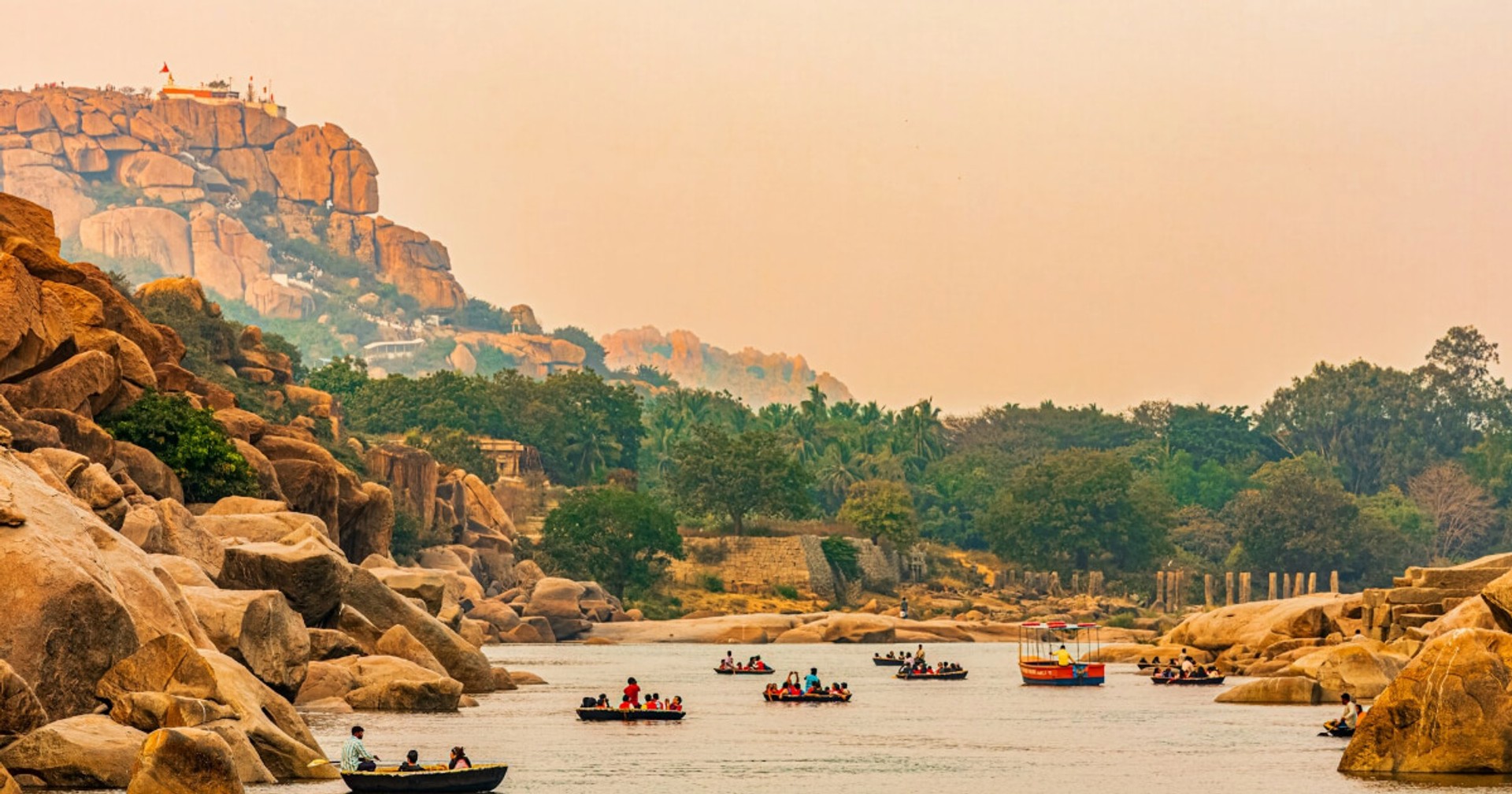

In 1443, the Persian diplomat Abdul Razzaq arrived in Hampi — then the capital of the Vijayanagara Empire, the wealthiest and most powerful kingdom in South Asia — and wrote that he had seen many cities, but none that could compare to this one. Its markets sold silk from China, pearls from the Arabian Sea coast, gemstones from the Deccan, and horses imported from Arabia. The population was approximately 500,000 people — which placed Vijayanagara, by the mid-15th century, among the four or five largest cities on earth.
In January 1565, the Battle of Talikota ended the Vijayanagara Empire's dominance. The Deccan Sultanate coalition — four allied kingdoms — won the battle, executed the empire's ruler on the battlefield, and marched on the capital. Over five months, from February to July 1565, they systematically destroyed it: temples, palaces, market streets, irrigation systems. In 1567, the Italian merchant Caesaro Federici visited the ruins. He wrote that the city's houses still stood, but empty, "and there is dwelling in them nothing, as is reported, but tigers and other wild beasts."
Two years. From the largest city in South Asia to an abandoned ruin inhabited by tigers.
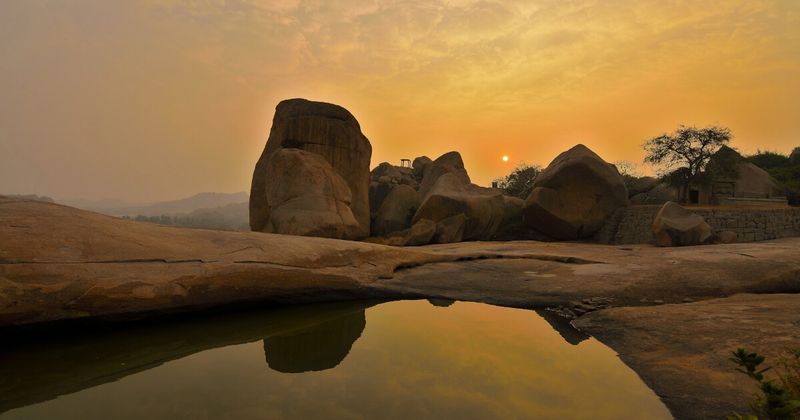
What the destroyers couldn't finish is what you walk through today. The Vittala Temple's Stone Chariot. The 56 musical granite pillars that produce different tones when tapped — not from hidden bells or hollow chambers, but from solid stone. The Lotus Mahal's Indo-Islamic arches, designed to cool a queen's summer residence. The Elephant Stables, where the royal war elephants were housed in chambers that outlasted the empire that built them. And the boulders — 2.5 to 3 billion years old, orange-pink granite piled in formations that look deliberately arranged but predate human existence by an incomprehensible margin.
Hampi is unlike any other UNESCO World Heritage Site in India. Not because the monuments are more intricate than Agra's or more numerous than Delhi's, but because the monuments and the landscape are the same thing — ancient ruins set in an ancient geological environment of a quality so visually extraordinary that the British writer Robert Sewell, who documented the ruins in 1900, couldn't find adequate language for it and simply described it as "the city of victory" and fell into lists of what he saw.
Two days is enough to understand it. Not enough to exhaust it — nobody exhausts Hampi in two days — but enough to feel its specific weight.
Sort VisitorsCoverage travel insurance before this trip. Hampi involves significant walking on uneven stone, boulder scrambling, and heat exposure. Policies from approximately $12–20 USD. EKTA offers a second option from $0.99/day at ektatraveling.com — worldwide, fully digital. Compare both.
2-Day Hampi at a Glance
| Day 1 | Day 2 | |
|---|---|---|
| Early morning | Hemakuta Hill at dawn | Virupaksha Temple aarti |
| Morning | Vittala Temple (arrive early) | Elephant Stables + Lotus Mahal |
| Afternoon | Stone Chariot in 3–4pm light | Royal Enclosure + Queen's Bath |
| Evening | Matanga Hill sunset | Tungabhadra coracle + riverside |
Getting to Hampi
Hampi is in central Karnataka, 376 kilometres from Bengaluru. There is no direct train to Hampi. The nearest railway station is Hospet Junction (also called Hosapete Junction), 13 kilometres from Hampi village.
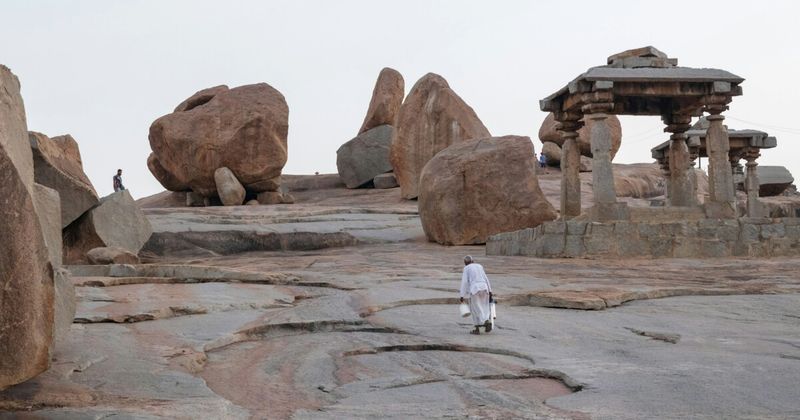
The Hampi UNESCO World Heritage Site is formally titled "Group of Monuments at Hampi" and was inscribed in 1986 — it covers 26 square kilometres and contains over 1,600 surviving structures including temples, pavilions, water systems, market streets, and elephant stables; what's not in the count is what was completely destroyed in 1565, which historians estimate was two to three times the volume of what survives.
From Bengaluru (the standard entry point):
Overnight bus — the most practical option for most visitors. Departs Bengaluru at approximately 9–10pm, arrives Hospet by 6–7am. Operators: KSRTC (government), SRS, VRL, Orangebus. Cost: ₹800–1,200 ($8.51–12.77 USD) for Volvo semi-sleeper; ₹1,200–1,800 ($12.77–19.15 USD) for AC sleeper. Book on 12Go Asia or directly via KSRTC website. The overnight bus saves a hotel night and puts you in Hospet at dawn — the correct timing for a Hampi arrival that begins at Hemakuta Hill.
Train to Hospet Junction — the Hampi Express (16591) departs Bengaluru (Yeshwantpur) at 10:00pm, arrives Hospet at 7:10am. Second Class Sleeper from ₹250 ($2.66 USD); AC 3-Tier from ₹700 ($7.45 USD). Book on 12Go Asia 2–3 weeks ahead. Comfortable, reliable, and the correct pace of travel for a site that doesn't reward urgency.
Private taxi from Bengaluru: ₹8,000–12,000 ($85.11–127.66 USD) one way, 6–7 hours. Book through KiwiTaxi for a fixed-fare pre-confirmed vehicle — the road passes through northern Karnataka's dry landscape and is straightforward, but the distance means a 6am departure from Bengaluru for a noon arrival.
From Hospet to Hampi village: auto-rickshaw ₹150–250 ($1.60–2.66 USD), 20 minutes.
Book your Bengaluru airport arrival transfer through GetTransfer if arriving by air — BLR handles the major international connections into Karnataka.
Activate Saily 5G eSIM — Hampi village and the main monument zones have reasonable coverage. Signal drops in some boulder sections and across the river. Drimsim is useful for the cross-river settlement and the outlying sites.
Where to Stay in Hampi
Hampi's accommodation divides into two distinct zones with different characters.
Hampi village (Sacred Centre side): On the same side as Virupaksha Temple, close to the main monuments and the bazaar. Budget guesthouses along the bazaar strip: ₹700–1,500 ($7.45–15.96 USD). Midrange: ₹2,000–4,000 ($21.28–42.55 USD). Louder, more traveller activity, walking distance to the Vittala Temple route. The curfew applies here — no alcohol in Hampi's Sacred Centre zone by local regulation.
Across the river (Virupapur Gaddi / "Hippie Island"): Reached by coracle boat (₹30/$0.32 USD per person, see below) — quieter, more relaxed, away from the main monument circuit. Budget bamboo huts and guesthouses: ₹800–2,500 ($8.51–26.60 USD). The tradeoff: you cross the river every time you visit monuments, which adds 15–20 minutes each direction but means arriving on the Hampi side feeling slightly more removed from it.
For a 2-day visit, staying on the village side is more practical — the early morning Hemakuta and Vittala visits don't require a river crossing.
Day 1: Sacred Centre and Vittala
Hemakuta Hill: 6am
Arrive at the base of Hemakuta Hill — the rocky elevated area immediately south-west of the Virupaksha Temple — before dawn. Entry: free. The hill is covered in a cluster of pre-Vijayanagara-era temples (7th–11th century, predating the empire by several hundred years), small shrines, and the extraordinary topography of Hampi's boulder landscape.
The point of 6am is the light. As the sun rises over the Virupaksha Temple's 50-metre gopuram to the east, the first horizontal light catches the tops of the surrounding granite boulders and the temple spire simultaneously — the orange-pink rock and the carved stone tower lit from the same angle. From Hemakuta's highest accessible boulder, the view north encompasses the full sweep of Hampi Bazaar below, the Tungabhadra river beyond, and the boulder landscape stretching to every horizon. No other viewpoint in Hampi provides this complete geographical overview, and no other time of day provides the light quality.
Give yourself 45 minutes on the hill. Walk slowly. The small temples scattered across the slope are centuries older than the empire most visitors come to see — they represent a Hampi that existed before Vijayanagara made it the most important city in South Asia.
The Virupaksha Temple sits at the foot of Hemakuta Hill — the oldest continuously functioning temple in Hampi, with a shrine origin in the 7th century and the current 50-metre gopuram built during the Vijayanagara period. Entry: free (camera ₹50, video ₹500). The morning aarti (approximately 6:30–7am) is worth attending — the priests, the bells, the oil lamp ceremonies in a temple that has been performing them without interruption for over 1,300 years. The temple's resident elephant (Lakshmi) is brought out for morning blessings — she takes ₹10 coins and touches devotees' heads with her trunk and has been doing this in the temple for decades.
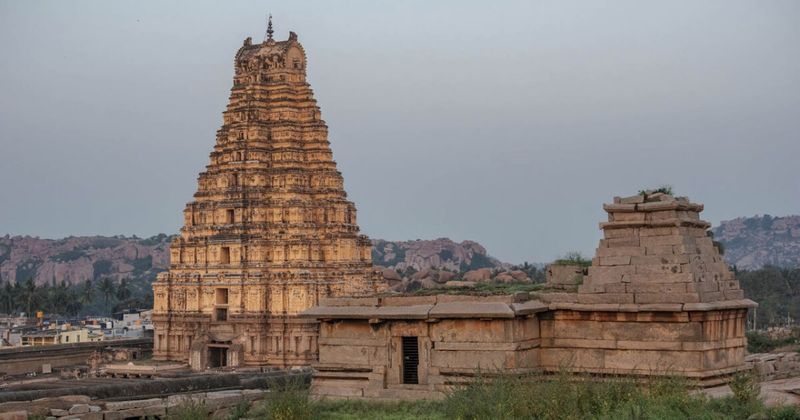
The Virupaksha Temple is dedicated to Shiva as Virupaksha — the consort of Goddess Pampa, for whom Hampi's river (Tungabhadra, locally called Pampa) and the city itself (Pampakshetra, the field of Pampa) were named before the Vijayanagara empire gave it the name Vijayanagara; the temple's unbroken continuity through the empire's rise, its destruction, and 460 subsequent years is why Hampi village still exists — the settlement around the functioning temple survived what the royal city could not.
One specific detail about the Virupaksha Temple: it contains a pinhole camera. In the dark passage off the main hall, a small hole in the wall allows light to project an inverted image of the gopuram onto the opposite wall — a natural camera obscura, functioning since the temple's medieval construction. It works best in the morning when the light is strong and directional. Ask a temple attendant to point it out.
Breakfast and the Hampi Bazaar
Return from the temple by 8:30am. The Hampi Bazaar — the 2.5-kilometre stone-paved market street that ran east from the Virupaksha Temple during the Vijayanagara period — is now a mix of small cafés, guesthouses, and shops where the original market stalls stood. The stone columns of the original bazaar are still visible along the street's length.
Breakfast: The cafés along Hampi Bazaar and near the bus stand serve South Indian breakfasts (idli, vada, masala dosa) for ₹60–120 ($0.64–1.28 USD) and filter coffee for ₹30–50 ($0.32–0.53 USD). Order before 9am for the freshest preparation. The banana pancake and traveller breakfast scene caters to the international crowd; if you want the South Indian version, walk slightly further from the main junction.
Rent a scooter here. Multiple shops along the bazaar rent scooters for ₹300–450 ($3.19–4.79 USD) per day. Leave a photocopy of your ID (the original stays with you). The 26 square kilometres of Hampi requires a vehicle — walking the full site in 2 days is physically impossible. Scooter is the correct solution. The roads between monuments are manageable for first-time scooter riders; the boulder landscape means you're never above 30kmph. Alternatively, book a full-day auto-rickshaw with a local driver through Intui.travel for approximately ₹1,200–1,500 ($12.77–15.96 USD) — useful if you'd rather not ride yourself.
Vittala Temple: 9am arrival, 3pm return
This is the most important timing decision in Hampi.
The Vittala Temple (Vijaya Vittala Temple) is the architectural masterpiece of the Vijayanagara Empire — and the reason most people come to Hampi. The Stone Chariot, the 56 musical pillars, and the sheer ambition of the carved stone complex justify the hyperbole that surrounds it. Entry for foreigners: ₹500 ($5.32 USD). Open 8:30am–5:30pm daily.
The last 2 kilometres to the temple gate are no-vehicle. Park your scooter at the designated lot and take the battery-operated vehicle (golf cart/electric bus): ₹10 per person one way. Or walk the 2 kilometres along the old Vittala Bazaar — the remaining columns of the original royal market street, worth walking slowly as the historical context accumulates.
Why morning AND afternoon both matter: Visit the temple when it opens at 8:30–9am. The complex is quiet. The light comes from the east, side-lighting the Stone Chariot's wheel carvings beautifully. Walk the full complex, spend time in the Ranga Mandapa (the hall of musical pillars), and then return to the Stone Chariot at 3–4pm — when the afternoon western light hits the eastern face of the chariot from behind the visitor, illuminating the carved detail completely differently. The two visits show two different temples. Day 1 is the morning visit. The afternoon return is built into the schedule deliberately.
The Stone Chariot. Built during the reign of Krishnadevaraya (1509–1529), the granite structure is a shrine to Garuda (Lord Vishnu's vehicle) fashioned in the form of a chariot — complete with carved stone wheels that were originally capable of rotating (locked in place during a later restoration). It is one of three famous stone chariots in India, the others being at Konark in Odisha and Mahabalipuram in Tamil Nadu. Krishnadevaraya is said to have been so impressed by the Konark Sun Temple's chariot that he commissioned a version at Vittala to demonstrate the Vijayanagara craftsmen's equivalence.
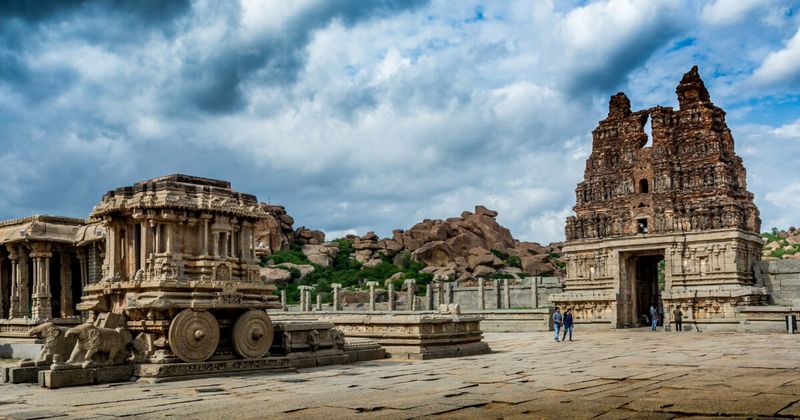
The Vittala Temple complex was never actually consecrated — it was under construction during the final decades of the Vijayanagara Empire and the installation of the main deity was never completed before the empire fell; this means that despite being the most elaborate temple complex in Hampi, the Vittala Temple has never functioned as a place of worship in the way the Virupaksha Temple has; it was built as a demonstration of the empire's cultural and craft supremacy, and the 1565 destruction interrupted it before it could serve any other purpose.
The Musical Pillars. The Ranga Mandapa (the main pavilion in front of the shrine) has 56 primary granite pillars, each wrapped with seven smaller pillars. When tapped gently — not struck, gently tapped — each of the smaller surrounding pillars produces a different musical tone: the seven surrounding each primary pillar correspond to the seven notes of the classical Indian musical scale (Sa, Re, Ga, Ma, Pa, Dha, Ni). The British colonial authorities, encountering this in the 19th century, reportedly cut two of the pillars open to find the hollow chambers or metal bells they assumed must be responsible for the sound. They found solid granite all the way through. The musical resonance is produced entirely by the vibrational properties of the granite at specific dimensions — no cavity, no mechanism, solid stone playing music. Modern acoustic scientists have studied the pillars and still cannot fully account for the phenomenon.
Touching the pillars is no longer permitted. A sign prohibits it. Most visitors do it anyway — gently. The temple guards enforce inconsistently.
Allow 2.5–3 hours for the full Vittala complex.
Pre-book entry through Klook — the ticket counter can have queues in peak season (November–February).
Matanga Hill: sunset
The highest point in the Hampi valley — a boulder hill approximately 1 kilometre east of the Virupaksha Temple. The climb takes 20–30 minutes over rough granite steps and boulders. Free. There is a small Shiva shrine at the top.
The view from Matanga Hill at sunset is the most complete panorama available in Hampi: the Virupaksha Temple gopuram and the Hampi Bazaar to the west, the Tungabhadra river valley to the north, the Vittala Temple site visible in the far distance, and the full boulder landscape spreading in every direction in the amber light of the last hour. As the light drops and the sky changes from gold to deep orange to purple, the boulders below gradually stop being orange and become dark silhouettes against the sky.
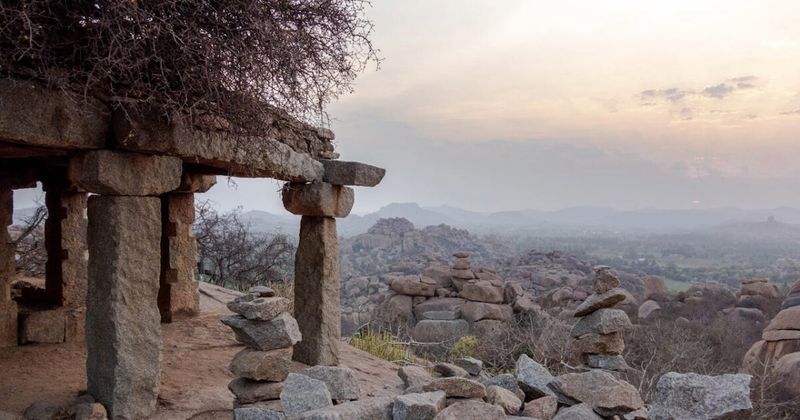
The name Matanga refers to the sage Matanga of the Ramayana — according to the epic, Hampi's boulder landscape (then called Pampakshetra) was the location where the exiled princes Rama and Lakshmana met Hanuman and the monkey king Sugriva while searching for Sita; the identification of Hampi as the Kishkindha of the Ramayana is one of the reasons the site has always been considered sacred, giving it a mythological depth that predates even the 7th-century temple beginnings by several thousand years in the oral tradition.
Go without your scooter — leave it at the base. The climb is not technically demanding but requires both hands at certain points. Wear shoes with grip.
The heat of mid-afternoon in Hampi (30–38°C in October–March, significantly worse in summer) makes the 12pm–3pm window the correct time for a hotel rest rather than monument-touring. The Matanga climb at 5pm, after the worst heat has passed, is manageable. At 4am it is also done by certain visitors for sunrise — bringing its own quality of light entirely.
Check Live Flight Prices
Day 2: Royal Centre and the River
Day 2 moves to the Royal Centre — the section of Hampi that was the Vijayanagara Empire's administrative and ceremonial core, approximately 3 kilometres south of the Sacred Centre. The monuments here are a different architectural register from the temples: secular structures, palace remains, water systems — the infrastructure of a functioning empire rather than its spiritual expression.
Morning: Virupaksha Temple aarti, 6:30am. If you're an early riser, the second morning begins the same way the first did — with the Virupaksha Temple at dawn. The morning aarti at 6:30am is brief (15 minutes), atmospheric, and attended mostly by local devotees rather than tourists at this hour. Free. Worth the 6am alarm.
Elephant Stables and Zenana Enclosure: 9am
Entry: ₹600 foreigners ($6.38 USD, single ticket covers Elephant Stables, Zenana Enclosure, Lotus Mahal, and Watch Tower). Open 6am–6pm.
The Elephant Stables — officially the Gajashaala — is one of the most visually distinctive structures in Hampi: a long, symmetrical row of 11 chambers, each with a different style of domed roof (some pointed, some rounded, some ribbed), all in the same ochre granite and mortar. These were the stalls for the royal war elephants. The alternating dome types on a single long building suggest a deliberate aesthetic decision — variety within unity, demonstrating the craftsmen's ability to execute multiple architectural vocabularies simultaneously.
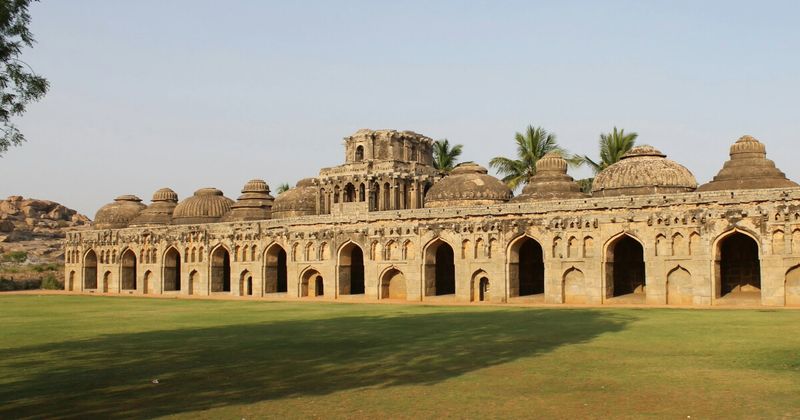
The Vijayanagara Empire maintained a war elephant corps of an estimated 500–900 animals at its height — the largest elephant military in India during the 15th century, larger than any contemporary Deccan Sultanate's — which contributed to the shock of its defeat at Talikota, where the Sultanate coalition used superior cannon fire to disrupt the elephant lines before they could engage; the tactical advantage that had defined Vijayanagara's military dominance for 150 years became irrelevant in a single afternoon of artillery.
The chambers are large enough to walk into. Stand inside one and look up at the corbelled dome above — the way the stone courses step inward to the central point without mortar, relying entirely on the mathematics of load distribution to hold. This is the same structural logic as the great dome builders of the Islamic world and medieval Europe, arrived at independently in Deccan India.
The Lotus Mahal is a few minutes' walk within the same enclosure: a two-storey pavilion with a ground floor of pointed Indo-Islamic arches and an upper storey of corbelled Hindu-style brackets, combining both architectural traditions in a single building. The official explanation is that it was a summer palace or audience hall for the queen. The name comes from the lotus-shaped finials on the upper terrace. The structure is extraordinary not because of its size — it's modest — but because of what it represents architecturally: a deliberate fusion of Hindu and Islamic design languages in a Hindu empire whose relationship with its Muslim neighbours was complicated and whose craftsmen were clearly absorbing influence from both traditions.
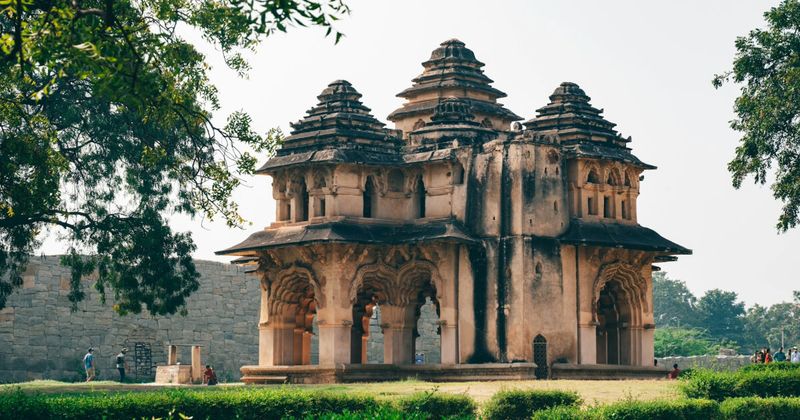
The Zenana Enclosure that contains the Lotus Mahal was the segregated compound of the royal women — zanana is derived from the Persian word for woman, reflecting the Persian cultural influence that permeated Vijayanagara's court despite its Hindu religious character; the enclosure's high walls, watch tower, and internal garden system represent a complete domestic landscape designed for a community of hundreds of women including queens, concubines, attendants, and servants, none of whose individual names were recorded in the historical documents that meticulously catalogued the kings.
Royal Enclosure and Hazara Rama Temple: 11am
The Royal Enclosure — the walled complex of ceremonial platforms, audience halls, and underground chambers that formed the king's public ceremonial centre — is free to explore after passing the monument zone. The Mahanavami Dibba (the Great Platform) is a multi-storeyed stone platform covered in carved friezes depicting processions of elephants, horses, dancing girls, and battle scenes — a visual record of the Dasara celebrations that the Vijayanagara kings conducted here annually. The Portuguese visitor Domingo Paes described these ceremonies in 1520: thousands of soldiers, hundreds of elephants in ceremonial dress, the king seated above the platform in gold-embroidered robes, and nine days of performance, sacrifice, and spectacle.
The Hazara Rama Temple (free, open access) within the Royal Centre is the private temple of the Vijayanagara kings — "Hazara" meaning "a thousand," a reference to the extraordinary density of carved narrative friezes covering the outer walls. The entire story of the Ramayana is carved in bands around the exterior, panel by panel, readable like a comic strip if you follow the frieze from the beginning. The interior of the mandapa has 16 extraordinary columns with pendant lotuses carved in the round — hanging stone flowers, seemingly suspended mid-fall from the ceiling, each carved from a single piece of granite.
Queen's Bath: afternoon
Free, open 6am–6pm. 500 metres south of the Elephant Stables. The royal bath is a square enclosed pool surrounded by an arcade of arched corridors with screened balconies above — the queen (or possibly the royal women's collective) would bathe in the central pool visible through ornate arched windows and corbelled balconies. Perfumed water from the surrounding moat was piped in. The structure was designed so that air movement through the arched corridors cooled the space — a passive cooling system built 500 years before air conditioning, using the same thermodynamic principle as the wind-catchers of Persian architecture.
The Queen's Bath is one of Hampi's least crowded sites despite being one of its most architecturally refined. Go in the afternoon when the light comes through the arcade arches at the right angle to illuminate the interior pool surface.
The Tungabhadra Coracle: afternoon
Hampi's other transport mode, beyond scooters: the coracle — a perfectly circular boat woven from bamboo and coated in buffalo hide or plastic tarpaulin, propelled by a single oarsman using a paddle in circular motions. The physics of coracle navigation require the paddler to generate forward momentum from a circular motion, which involves spinning the boat slightly in the current. The sensation for passengers is of gentle, constant rotation combined with forward movement — disorienting and delightful.
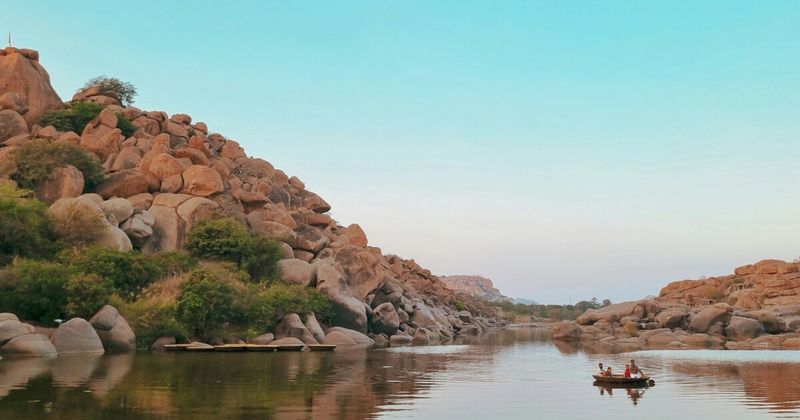
The coracle (known locally as a teppa or antu) is one of the oldest boat designs in the world — circular watercraft of woven material have been documented in India, Britain (the Welsh coracle), and Iraq (the quffa) since ancient times, each arrived at independently as a solution to the problem of crossing fast-moving shallow rivers in regions where straight-grained timber for planking was unavailable; the Tungabhadra coracle tradition has continued through the Vijayanagara period, its sacking, and four subsequent centuries without significant change to the design.
Coracle crossing: ₹30 per person ($0.32 USD), from the main Hampi ghat near the Virupaksha Temple to the settlement across the Tungabhadra. The river here is clear, relatively shallow in summer, and fast in monsoon. The crossing takes 10–15 minutes.
The river crossing is not just transport — it's the most immediately sensory Hampi experience, the one that puts the historical landscape into physical relationship with the body rather than just the eyes. The view of the Virupaksha gopuram from the middle of the Tungabhadra, the boulders rising on both banks, the ruins visible above the treeline — this is what Portuguese and Persian travellers would have seen approaching the capital by river.
What to Skip in 2 Days
The Archaeological Museum at Kamalapura. 5 kilometres south of the main monument zone, this ASI museum has a scale model of the original Vijayanagara city, stone sculptures, and inscriptions from the site. Entry: ₹40 ($0.43 USD); closed Fridays. Worth it on a 3-day Hampi visit; not worth the time on 2 days when the actual monuments above ground are more rewarding.
Anegundi village (across the river and upstream). The ancient capital before Vijayanagara, with its own temples and the Kishkindha cave associations from the Ramayana. Fascinating and easily a half-day. It doesn't fit into 2 days without sacrificing either the Royal Centre or Vittala — both of which take priority.
Every temple in the boulder field. Hampi's outlying boulder landscape contains dozens of small temples, viewpoints, and ruined pavilions reachable only by scrambling over boulders — rewarding for those with 3–4 days, time-consuming rabbit holes for those on 2 days. The Sule Bazaar and Achyutaraya Temple (east of Vittala) are the best of these outliers if you have a free afternoon hour.
The Vittala Temple at midday. The light is flat and the heat is at its worst. The afternoon visit (3–4pm) is worth its own trip specifically.
Pace and Burnout: Managing Hampi
Hampi has a specific pace trap: the site is so visually overwhelming — every boulder arrangement a potential photograph, every corridor another carved frieze — that visitors try to cover everything and end up exhausted by 2pm with a blurred memory of undifferentiated stone. The correct Hampi approach is to spend more time in fewer places.
Hampi's designation as a UNESCO World Heritage Site has had an unusual administrative consequence: the Government of Karnataka and the Archaeological Survey of India have periodically been in conflict with local residents about construction within the heritage zone.
The Vittala Temple deserves 2.5–3 hours. Most visitors spend 45 minutes and feel vaguely unsatisfied. The musical pillars, if you stand in the Ranga Mandapa and simply listen to the ambient sounds, produce a resonance in the stone floor that's perceptible through the feet. The Stone Chariot, if you walk around the full base and read the carved friezes at close range, takes 20 minutes just for the base panels. The surrounding pavilions have decorative detail that requires slow looking, not glancing.
Sit on a boulder at some point. Not to photograph it — just to sit. The 3-billion-year-old granite is warm from the sun. The ruins below don't require commentary. The landscape that Abdul Razzaq couldn't describe adequately in 1443 and that Caesaro Federici found only tigers in by 1567 is available for unmediated experience whenever you stop walking.
Best season: October–February. November–January is peak (book accommodation 2–3 weeks ahead). The heat in March–May makes the boulder-climbing elements impractical. Monsoon (June–September) brings dramatic landscapes and reduced crowds but some monument paths become slippery.
For South India planning that includes Hampi in a larger circuit, our Kerala 7-Day guide covers the coastal extension, and our North India vs South India guide helps position Hampi within a broader India trip.
2-Day Hampi Budget Breakdown
| Expense | Budget | Mid-Range |
|---|---|---|
| Overnight bus Bengaluru → Hospet | ₹800–1,200 ($8.51–12.77) | ₹1,200–1,800 ($12.77–19.15) AC sleeper |
| Auto Hospet → Hampi | ₹150–250 ($1.60–2.66) | ₹150–250 |
| Accommodation (2 nights) | ₹700–1,500 ($7.45–15.96)/night | ₹2,000–4,000 ($21.28–42.55)/night |
| Scooter rental (2 days) | ₹600–900 ($6.38–9.57) total | — |
| Auto + driver Intui.travel | — | ₹1,200–1,500 ($12.77–15.96)/day |
| Vittala Temple (foreigner) | ₹500 ($5.32) | ₹500 ($5.32) |
| Elephant Stables/Zenana/Lotus Mahal | ₹600 ($6.38) | ₹600 ($6.38) |
| Virupaksha Temple | Free (camera ₹50) | Free |
| Hemakuta Hill | Free | Free |
| Queen's Bath | Free | Free |
| Matanga Hill | Free | Free |
| Coracle crossing (2 trips) | ₹60 ($0.64) | ₹60 ($0.64) |
| Battery vehicle to Vittala | ₹20 ($0.21) roundtrip | ₹20 ($0.21) |
| Food (2 days) | ₹300–500 ($3.19–5.32)/day | ₹800–1,500 ($8.51–15.96)/day |
| Klook guide/experiences | — | ₹800–1,500 ($8.51–15.96) |
| Travel insurance | VisitorsCoverage/EKTA from ~$12 | from ~$12 |
| 2-day total per person (excl. Bengaluru flight) | ₹7,000–12,000 ($74–$128) | ₹18,000–28,000 ($191–$298) |
All prices INR. USD at ₹94 = $1. INR prices reliable; USD approximate.
Check Live Flight Prices
Your Hampi Trip Planning Checklist
🛡️ Travel Insurance — First, Always: VisitorsCoverage — Boulder scrambling and heat exposure need minimum $100K USD medical cover; from ~$12–20 USD | EKTA — Second option from $0.99/day at ektatraveling.com; 24/7 support, worldwide digital coverage. Compare both.
✈️ Flights & Connections: FlyFlick — Fly into Bengaluru (BLR), then overnight bus or train to Hospet | Compensair — Claim up to €600 for delayed/cancelled flights; EU-connected return legs from BLR carry full eligibility.
🚂 Getting to Hampi — Book 2–3 Weeks Ahead: 12Go Asia — Book the Hampi Express (16591) Bengaluru Yeshwantpur → Hospet Junction (departs 10pm, arrives 7:10am, Sleeper from ₹250) or overnight Volvo bus from Bengaluru Majestic to Hospet (₹800–₁,200). Book both outbound and return simultaneously — Bengaluru-bound buses from Hospet during peak season sell out.
🚖 Local Transfers: GetTransfer — Pre-booked fixed-fare Bengaluru airport transfer to your Bengaluru hotel or bus terminal | KiwiTaxi — Bengaluru airport confirmed | Intui.travel — Full-day auto-rickshaw with local driver for the 26 sq km monument circuit; fixed fare, no negotiation.
🎟️ Experiences to Pre-Book: Klook — Vittala Temple entry ₹500 foreigners (avoids ticket counter queues in peak season); guided Hampi heritage walk; Vittala Temple + Elephant Stables combined guided tour.
📱 Connectivity: Saily — 5G eSIM; good coverage in Hampi village and main monument zones | Drimsim — Off-grid eSIM; useful across the Tungabhadra at Virupapur Gaddi and outlying boulder sites.
The boulders are 3 billion years old. The ruins are 460. Both will outlast your hurry.