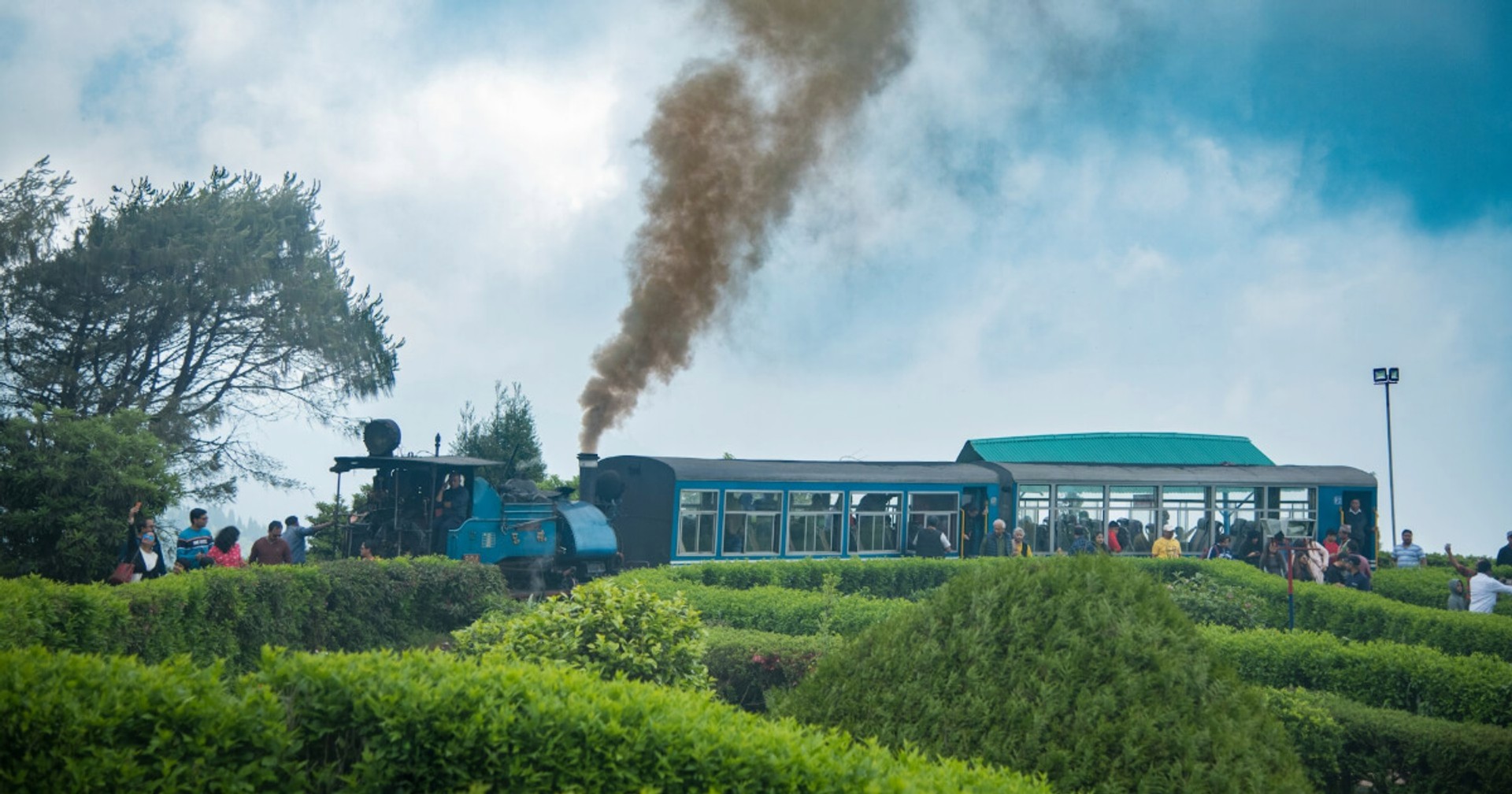

Most of what the world sells as "Darjeeling tea" is not Darjeeling tea.
The genuine article — certified first flush, produced within a specific altitude band in the Darjeeling hills, carrying India's first-ever Geographical Indication (GI) tag, granted in 2004 — amounts to roughly 7 to 8 million kilograms per year. Global annual sales of tea marketed under the Darjeeling name exceed 40 to 50 million kilograms. The mathematics are not subtle. Most of what Harrods sells, most of what the supermarkets of Germany and Japan and the United States label "Darjeeling," is either a blend or an imitation.
The GI logo on a packet of tea purchased at a plantation in Darjeeling is the only form of proof available to a buyer that the tea inside is the actual product — the two leaves and a bud plucked from a specific elevation in the specific hills you're looking at from the veranda of your hotel. The first flush (mid-March to April) can command ₹10,000–15,000 ($106–160 USD) per kilogram at auction. You can buy 50 grams at the plantation for ₹400–1,500 ($4.26–15.96 USD). The same tea at Harrods costs several times that in sterling.
This is Darjeeling's specific character: a place producing something the world has spent 150 years imitating, whose real version most people have never actually tasted.
Sikkim is Darjeeling's complement — an entire Himalayan state the size of a small European principality, sharing Kanchenjunga's slopes, containing some of the finest monasteries in the eastern Himalayas, and accessible to international visitors through a permit system that requires understanding but rewards those who navigate it with landscapes and quiet that the overtouristed North India circuits don't provide.
Eight days, properly planned, gives you both. Three days in Darjeeling, three days in Sikkim, two days of transit and flexibility. At altitudes ranging from 2,042 metres (Darjeeling) to 3,753 metres (Tsomgo Lake) — challenging in terms of acclimatisation but not the oxygen-tent territory of Leh, which sits at 3,524 metres and rises further into the passes. The eastern Himalaya is kinder than the western.
Sort VisitorsCoverage travel insurance before this trip. The circuit involves significant altitude variation, mountain weather unpredictability, and remote road conditions. Policies from approximately $18–35 USD. EKTA offers a second comparison option from $0.99/day at ektatraveling.com — worldwide, fully digital, 24/7 support. Compare both before booking
8-Day Circuit at a Glance
| Day | Location | Focus |
|---|---|---|
| Day 1 | NJP → Darjeeling | Transit, acclimatise, evening Mall Road |
| Day 2 | Darjeeling | Tiger Hill 4am, Toy Train, Batasia Loop |
| Day 3 | Darjeeling | Tea plantation, Ghum Monastery, Padmaja Zoo |
| Day 4 | Darjeeling → Gangtok | Transit, Rumtek Monastery, MG Marg |
| Day 5 | Gangtok + Tsomgo Lake | PAP day trip, 3,753m lake, Baba Mandir |
| Day 6 | Gangtok → Pelling | Transit through West Sikkim, check in |
| Day 7 | Pelling | Pemayangtse Monastery, Rabdentse ruins, Kanchenjunga |
| Day 8 | Pelling → NJP → Depart | Return to Bagdogra/NJP, fly home |
Getting There: The NJP Gateway
New Jalpaiguri (NJP) railway station and Bagdogra Airport (IXB) — 10 kilometres apart in the plains of West Bengal — are the entry and exit points for this entire circuit. All trains from Kolkata, Delhi, and Mumbai arrive at NJP. All flights arrive at Bagdogra. The hills begin immediately north.
Search and book flights into Bagdogra on FlyFlick. Direct connections from Delhi (1hr 45min, from ₹3,500/$37.23 USD), Kolkata (45min, from ₹1,800/$19.15 USD), and seasonal connections from Mumbai. Set a Compensair alert — IXB is a small airport and fog delays in winter cascade into connecting travel.
By train to NJP: the Darjeeling Mail (13149) from Kolkata Sealdah (overnight, 10hrs) and several express services from Delhi, Guwahati, and Patna. Book on 12Go Asia with international card support — 3–4 weeks ahead during October–December peak.
Book your NJP/IXB arrival transfer through GetTransfer or KiwiTaxi — confirmed for NJP and Bagdogra routes.
NJP to Darjeeling: Shared jeep from NJP Jeep Stand — ₹250–₃00 ($2.66–₃.19 USD) per person, approximately 3 hours via Hill Cart Road. Book a full vehicle through Intui.travel — ₹3,500–5,000 ($37.23–53.19 USD) — if arriving late or with luggage. The toy train's full NJP-to-Darjeeling route takes 7–8 hours and operates on limited diesel services; scenic but impractical for arrival day.
Activate Saily 5G eSIM before arriving — good in Darjeeling town and NJP/Bagdogra; coverage varies in Sikkim valleys. Drimsim handles the mountain areas and Tsomgo Lake road where single-carrier SIMs drop.
The Sikkim Permit System: What Foreigners Actually Need to Do
Get this right before arrival — it determines the entire Sikkim section of the trip.
Step 1 — Restricted Area Permit (RAP) / ILP: All foreign nationals require an RAP (also called ILP — Inner Line Permit) to enter Sikkim. This is issued free at:
- Rangpo checkpoint (on the road from Darjeeling to Gangtok — the standard route into East Sikkim)
- Melli/Ramam checkpoints (on routes into West/South Sikkim from West Bengal)
- Darjeeling DM Office — if already in Darjeeling before heading to Sikkim
The RAP covers: Gangtok, Rumtek, and most of West Sikkim including Pelling. Your driver and hotel both need to see it. The process at Rangpo takes approximately 10–15 minutes. Bring: passport, Indian visa copy, two passport-sized photographs. Your driver or hotel can arrange the paperwork if given details 24 hours ahead.
Step 2 — Protected Area Permit (PAP) for Tsomgo Lake: Tsomgo Lake is a Protected Area. Foreigners require a PAP in addition to the RAP. Rules:
- Minimum group of 2 foreign nationals — solo foreign travellers cannot get a PAP
- Must be arranged through a registered Sikkim tour operator (your Gangtok hotel or a Gangtok agency)
- Cost included in the shared vehicle package: approximately ₹800–1,000 ($8.51–10.64 USD) per person
- The permit is issued for a specific day-trip and is non-transferable
What foreigners CANNOT visit: Nathula Pass, Gurudongmar Lake, Zuluk — all off-limits to foreign nationals regardless of permit type. No exceptions.
Practical summary: Arrange RAP at Rangpo on arrival from Darjeeling. Arrange Tsomgo PAP through your Gangtok hotel on the day before the lake visit. Book through Klook for a combined Tsomgo Lake tour with permit handling included.
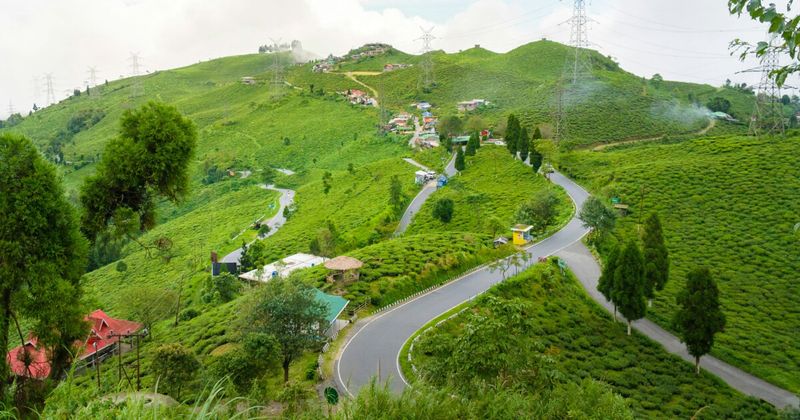
Darjeeling tea is harvested in four flushes per year — first flush (March–April) produces the lightest, most floral tea and commands the highest prices at auction; second flush (May–June) is fuller-bodied with a muscatel note that connoisseurs consider the finest expression; monsoon flush (July–September) is lower quality; autumn flush (October–November) is mid-range; the first flush harvest is so short — approximately six weeks — that the global supply of genuine first flush Darjeeling tea is exhausted within months of release each year.
Day 1: NJP to Darjeeling — The Road That Earns the Arrival
The 3-hour drive from NJP to Darjeeling on Hill Cart Road covers a 2,000-metre elevation gain through 16 hairpin bends, tea plantations, waterfalls, and the specific quality of light that comes from being inside a cloud. By the time you arrive in Darjeeling, your ears have popped twice and the temperature has dropped 10 degrees.
Check into your hotel and resist the temptation to do too much on Day 1. The altitude — 2,042 metres — is enough to cause mild headaches in visitors arriving from sea-level cities. Drink water. Walk slowly. Take the evening at Mall Road and Chowrasta (the pedestrian square at the top of the town) at the pace the altitude dictates.
Chowrasta at dusk: The colonial-era promenade at the top of Darjeeling — the old bandstand, the horse rides, the tea stalls, the extraordinary view north toward Kanchenjunga when the clouds briefly part. This is where Darjeeling's social life concentrates — retired Gorkha officers, school children in uniforms from the famous residential schools (Darjeeling has been educating India's elite since the British established the hill station in the 1840s), and international trekkers planning routes. The air at 2,042 metres in October tastes different from the air of the Indian plains. Breathe it.
Dinner: The Glenary's Bakery and Restaurant on Nehru Road — a Darjeeling institution since 1935, the original colonial-era bakery producing the best pork dishes in the hills. Order the pork chops. ₹300–450 ($3.19–4.79 USD) per main. The warm dining room, the wood panelling, and the hill-station ambience are worth the meal independently of the food.
Day 2: Tiger Hill, the Toy Train and the Batasia Loop
Set your alarm for 3:15am.
Tiger Hill: 4am
Tiger Hill is 11 kilometres from Darjeeling town at an altitude of 2,590 metres — the premier sunrise viewpoint for Kanchenjunga and, on exceptionally clear days, a partial sightline toward Everest's summit 215 kilometres away. Shared jeeps from the town centre depart from approximately 3am; book a seat through your hotel or at the stand near Clubside taxi park the previous evening.
Entry: ₹50 ($0.53 USD) basic access. VIP viewing room (heated, indoor, with chairs): ₹100 ($1.06 USD). Book Klook's Tiger Hill sunrise tour through Klook for confirmed jeep pick-up and a guaranteed spot.
Budget accommodation near Chowrasta: ₹800–1,500 ($8.51–15.96 USD). Midrange hotels with Kanchenjunga-facing windows: ₹3,000–7,000 ($31.91–74.47 USD). Book 3–4 weeks ahead for October–December peak.
The crowd at Tiger Hill in October is significant. The specific viewing quality insight most guides miss: walk slightly downhill and left from the main platform's centre, toward the lower left railing. The sightline from here is less obstructed by the crowd and gives a cleaner left-edge view of the full Kanchenjunga massif as it emerges.
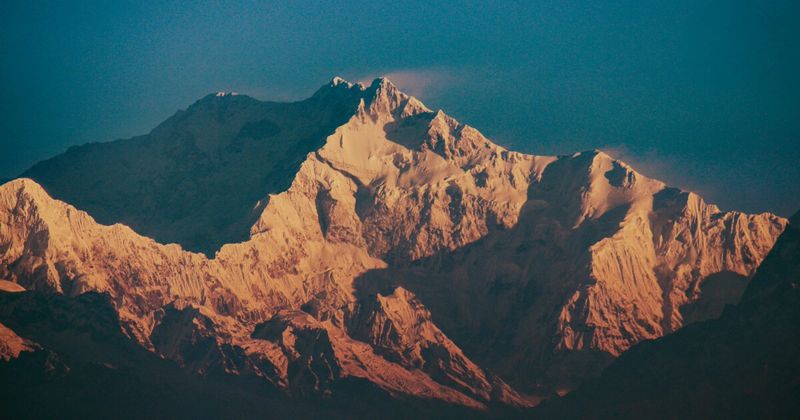
Tiger Hill's name has nothing to do with tigers — it derives from the Nepali word "Tugur," meaning white snow; the British anglicised it to Tiger Hill in the hill-station period, a transformation typical of how English-language maps throughout the subcontinent replaced local toponyms with phonetically plausible but etymologically unrelated English words; the original meaning, "white snow hill," is a more accurate description of what you're looking at.
What you're actually seeing: Kanchenjunga — at 8,586 metres, the third-highest mountain on earth, sitting on the border between Sikkim and Nepal. The name means "Five Treasures of Snow" in Tibetan — the five summits are repositories of gold, silver, gemstones, grain, and holy books according to the tradition. The Sikkimese consider the mountain sacred and have prohibited summiting the true highest point; every climbing expedition since 1955 has agreed to stop several metres short of the actual summit out of respect.
In October–November, when the post-monsoon sky is clear, Kanchenjunga appears from Tiger Hill as a five-peaked massif, its flanks catching the alpenglow in the minutes before the sun crests the horizon — a progression from pale pink to rose to gold to white over approximately 20 minutes. Photograph it. Then put the camera down and simply look.
Toy Train Joy Ride: 9am
Return to Darjeeling town by 7am, breakfast, and be at Darjeeling Railway Station by 9am for the Joy Ride.
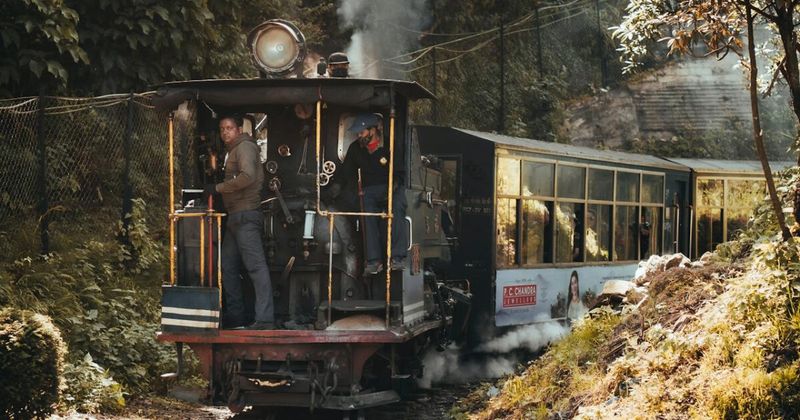
The Batasia Loop was specifically designed to eliminate a Z-reversal on the original track — the train had previously been required to reverse direction twice in a zigzag pattern to descend this section, which added time and created operational difficulties; the 1919 loop solved this by letting the train descend in a circle, gaining the necessary altitude change without reversals; it was an engineering solution that inadvertently created Darjeeling's most photographed viewpoint.
The Darjeeling Himalayan Railway — UNESCO World Heritage Site since 1999 — has operated on its 2-foot narrow gauge since 1881. The Joy Ride runs from Darjeeling station to Ghum (India's highest railway station at 2,258 metres) and back, with a 10-minute stop at the Batasia Loop. Duration: approximately 2 hours return.
Ticket prices: Diesel engine: ₹805 ($8.56 USD). Steam engine (the heritage B-class locomotive, the authentic experience): ₹1,405 ($14.95 USD). Book on IRCTC (irctc.co.in — international card supported) or through Klook. Several joy rides operate during the day, and during high seasons, there could be 18–20 rides a day, but steam engine rides are limited — book 2–3 weeks ahead for October–February peak.
The steam engine version is worth the price difference. The B-class locomotive was built in Britain in the late 19th century and burns coal; the sound, the smell, the rhythm, and the sight of it navigating the narrow track through Darjeeling's bazaar streets — often with market stalls 50cm from the carriage window — constitute an experience that photographs cannot adequately represent.
Batasia Loop: The Batasia Loop is open from 6am to 5pm; entry ₹20 per person, free for those who have toy train tickets. The loop was built in 1919 to eliminate a problematic zigzag reversal on the descent from Ghum — by constructing a spiral loop, engineers allowed the train to descend a full circle while gaining 40 metres of elevation change. At the centre of the loop sits the Batasia Eco Garden and the Gorkha War Memorial — a 3-metre bronze statue of a Gorkha soldier, commemorating those killed in conflicts from World War I through the Kargil War. On a clear day, the view of Darjeeling town from the loop, with Kanchenjunga behind it, is the most complete panorama of the hill station available from any point on the toy train route.
Ghum Monastery (Yiga Choeling Gompa): 2-minute walk from Ghum station during the 30-minute stop. Built in 1850 — the oldest monastery in the Darjeeling hills, belonging to the Gelugpa sect (the Yellow Hat tradition, the same school as the Dalai Lama). The 4.5-metre statue of Maitreya Buddha (the future Buddha) inside the main prayer hall is lit by a continuous ring of butter lamps. Free. Remove shoes.
Day 3: Tea Plantation, Ghum Monastery and the Zoo
Day 3 moves at a slower pace — the altitude requires it, and Darjeeling rewards it.
Happy Valley Tea Estate: 9am. 3 kilometres from Mall Road, walkable or by taxi (₹100–150/$1.06–1.60 USD). Founded in 1854, it's one of Darjeeling's most accessible estates for visitors. Guided plantation tour including processing factory visit: ₹50–200 ($0.53–2.13 USD) per person depending on guide. The tour covers: the plucking (done by hand by experienced workers who can pluck 30–35 kg of leaves per day — only the top two leaves and a bud from each shoot are taken, everything below discarded), the withering room (leaves spread on mesh trays and dehydrated over 12–16 hours), the rolling machines, the fermentation room (where the oxidation that produces black tea's colour and flavour occurs), and the drying kilns.
Buy at the estate shop. Look for the Darjeeling GI logo — the outline of a teapot with "Darjeeling" written beneath it. If the packet doesn't have this logo, it is not certified Darjeeling tea. Prices at estate shops: ₹200–1,500 ($2.13–15.96 USD) per 50g depending on flush and grade.
Padmaja Naidu Himalayan Zoological Park: 11am. Established in 1958 at 7,000 feet, this is the highest-altitude zoo in India and one of the world's few institutions with a successful breeding programme for the red panda — a species endemic to the eastern Himalayan forests and critically vulnerable. Entry: ₹100 foreigners ($1.06 USD). Open 8:30am–4:30pm, closed Thursdays. The snow leopard enclosure, the Tibetan wolf, and the red pandas are the essential stops. The zoo also houses the Himalayan black bear and the Asiatic black bear in separate enclosures on a hillside where the mist comes and goes during the visit. Pre-book through Klook.
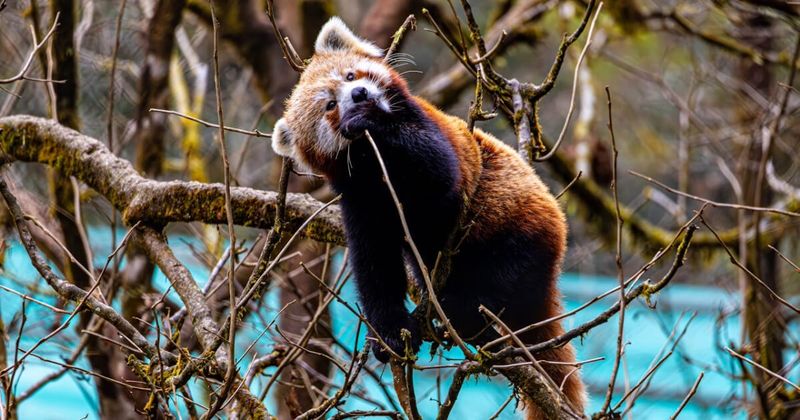
Caption: The red panda (Ailurus fulgens) — which shares the name "panda" with the giant panda but is not closely related, belonging to its own taxonomic family Ailuridae — was actually the first animal to be called a panda in Western scientific literature; the giant panda was named afterward, borrowing the existing term; the red panda was described by European science in 1825, 55 years before the giant panda was described; it is endemic to the eastern Himalayan forests of Nepal, Bhutan, northeast India, and southwest China.
Afternoon: The Natural History Museum near Chowrasta (₹10 entry, one of the cheapest museum tickets in India) houses a Victorian-era collection of Himalayan taxidermy and butterfly specimens assembled by the British in the 19th century — extraordinary in its own way as a document of colonial natural history rather than contemporary conservation.
Dinner: Kunga Restaurant on Gandhi Road — a Tibetan and Chinese restaurant in Darjeeling for decades, serving thukpa (noodle soup), momos (dumplings), and Tibetan butter tea (po cha — salty, buttery, an acquired taste that merits one cup on principle). ₹150–300 ($1.60–3.19 USD) per main. The momos at Kunga are the standard against which all subsequent Himalayan dumplings will be measured.
Check Live Flight Prices
Day 4: Darjeeling to Gangtok via Rumtek
The drive from Darjeeling to Gangtok covers approximately 100 kilometres and takes 3–4 hours depending on road conditions and the Rangpo border crossing. This is the day you get your Sikkim RAP.
Depart by 8am. Book a full vehicle through Intui.travel for the Darjeeling–Gangtok transfer — shared jeeps from the stand are available at ₹350–400 ($3.72–4.26 USD) per seat but stop at Rangpo for the permit process, which is smoother with a prearranged driver who has handled it before.
Rangpo: The Sikkim border town. Your RAP is processed here — 10–15 minutes with passport and photographs. Send passport scan and photos to your driver 24 hours ahead so the paperwork is pre-filled. The RAP is free. Keep it for the duration of your Sikkim stay — hotels and internal checkpoints require it.
Rumtek Monastery: en route. 24 kilometres from Gangtok, on the Darjeeling–Gangtok road's final approach. The largest monastery in Sikkim, home to the Kagyu (Black Hat) lineage of Tibetan Buddhism — a different school from Ghum's Gelugpa lineage. Rumtek was reconstructed in the 1960s by the 16th Karmapa, Rangjung Rigpe Dorje, who fled Tibet after the Chinese occupation and established the monastery as the seat of the Kagyu school in exile. Entry: free. Open to visitors 8am–6pm.
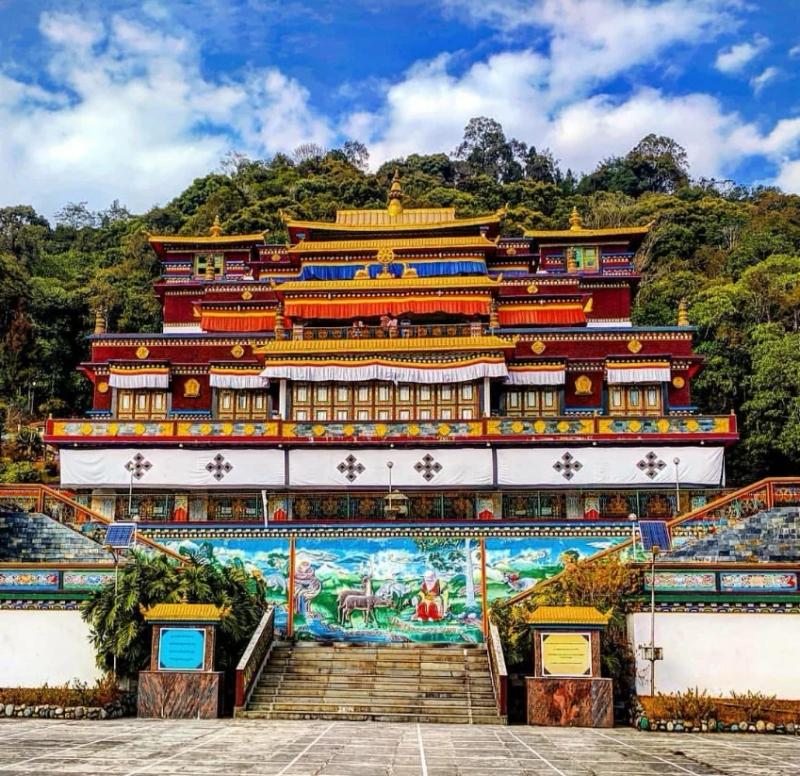
Rumtek Monastery houses the Golden Stupa reliquary of the 16th Karmapa — a large gold-covered structure containing his cremated remains and sealed by a lid said to have been placed by the Karmapa himself during his final illness; the reliquary is considered among the most sacred objects in Kagyu Buddhism, and the monastery's security apparatus around it is considerable, reflecting both its religious significance and a contested succession dispute over the 17th Karmapa that has involved both the Indian government and the Chinese government since the 1990s.
The main monastery building is a 4-storey structure with gilded roof ornaments visible from the approach road — the golden finials and the monastery's position above a forested valley create one of the more dramatically sited religious buildings in India. Inside: the main prayer hall with its central Karmapa throne, the gold-covered reliquary of the 16th Karmapa himself, and the extraordinary dark corridors lined with prayer wheels and thangkas (painted scroll paintings of Tibetan Buddhist iconography). Monks in maroon robes conduct their daily activities throughout the complex regardless of visitor presence.
Specific Rumtek detail: The 16th Karmapa is credited with a remarkable piece of intercultural observation. During one of his early tours of the United States in the 1970s, he reportedly said that Westerners have a great deal of mind but very little heart, while Eastern people have much heart but are using their minds insufficiently — and that the real need was for the two traditions to meet and learn from each other. This came from a man who had spent decades rebuilding an institution from exile after his homeland was occupied. The equanimity of that observation is very Rumtek.
Arrive in Gangtok by early afternoon. Gangtok is Sikkim's capital at 1,650 metres — more compact than Darjeeling, cleaner, with the administrative architecture of a small state capital and the MG Marg pedestrian street as its social centre. Budget hotels from ₹1,000–2,000 ($10.64–21.28 USD); midrange from ₹3,000–6,000 ($31.91–63.83 USD). Book in advance — Gangtok has limited quality rooms.
MG Marg evening: The pedestrianised market street of Gangtok is a pleasant hour. The ropeway (cable car) above the town runs approximately 1 kilometre and gives aerial views over Gangtok and the Rangpo River valley — ₹100–200 ($1.06–2.13 USD) per person. Arrange the Tsomgo Lake PAP for tomorrow through your hotel this evening.
Day 5: Tsomgo Lake — The Permit Day Trip
Tsomgo Lake (also spelled Changu Lake) sits at 3,753 metres, 40 kilometres east of Gangtok on the road toward Nathula Pass. It is the accessible limit of East Sikkim for foreign nationals.
Your operator arranges the PAP and vehicle the night before. The shared vehicle package (₹800–1,000/$8.51–10.64 USD per person) covers: the PAP permit, the vehicle, a licensed guide, and the return trip. Depart Gangtok by 8am — the road is one-way in sections and vehicle convoys are timed. Your guide handles all checkpoint presentations en route.
Tsomgo Lake: At 3,753 metres, the oval glacial lake is accessible year-round to permitted visitors, though winter (December–March) can see it partially frozen. The surrounding landscape shifts depending on season — snow-covered in winter, wildflowers in spring (May–June), when primroses and potentilla cover the banks. In autumn (October–November), the lake is clear, the sky is deep blue, and the reflection of the surrounding peaks in the still water is complete.
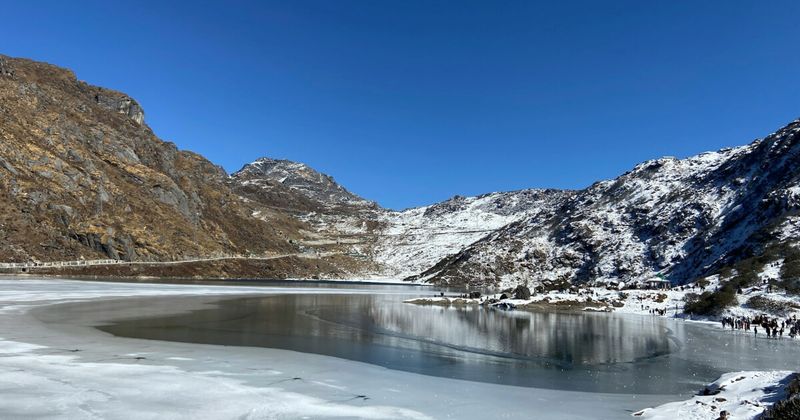
Caption: Tsomgo Lake is fed by glacial meltwater from the surrounding peaks — the lake level varies seasonally and the water is considered sacred by both the local Sikkimese and the Tibetan community across the Nathula Pass; in spring, the migratory bar-headed geese — the highest-flying migratory bird in the world, documented crossing the Himalayas at altitudes above 8,000 metres — stop at Tsomgo on their journey from the Tibetan plateau toward lower wintering grounds in India, making the lake a significant stopover on one of the world's most demanding migration routes.
The altitude here is noticeable — approximately the same as Leh city, though reached in a shorter time frame. Walk slowly. The mild oxygen deficit at 3,753 metres produces light-headedness in visitors arriving from 1,650-metre Gangtok in the same morning. Sit by the lake. Drink water. Do not rush.
Yaks are kept at the lakeside and can be ridden for ₹100–200 ($1.06–2.13 USD) — a yak ride beside a Himalayan glacial lake is one of those experiences that photographs implausibly well.
Baba Mandir: 5 kilometres past Tsomgo on the road toward Nathula. The shrine of a Sikh soldier — Harbhajan Singh — who died near here in 1968 and whose spirit, according to the tradition of the Indian Army personnel stationed in this border area, continues to protect the soldiers at the post. This is not folklore in the tourist-attraction sense; it is an active military shrine maintained by the Army, believed in by the serving personnel, and visited as a place of genuine devotion. The permit covers Baba Mandir. It does not cover the Nathula Pass itself — foreigners stop at Baba Mandir.
Return to Gangtok by afternoon. Rest. The altitude and the drive take more from you than a flat-terrain equivalent.
Day 6: Gangtok to Pelling — West Sikkim
The drive from Gangtok to Pelling (West Sikkim) covers approximately 115 kilometres and takes 3–4 hours. Book a full vehicle through Intui.travel — the road passes through Ravangla in South Sikkim (offering a potential stop at the Buddha Park, a 130-foot seated Buddha statue with Kanchenjunga behind it) and through the increasing lushness of West Sikkim's lower valleys.
Pelling sits at approximately 2,150 metres on a ridge in West Sikkim. It is a small hill town whose extraordinary quality is simple: on clear mornings, Kanchenjunga's full massif is visible from within the town, seemingly close enough to touch. Hotels with Kanchenjunga-facing windows — and in Pelling, most midrange hotels have them — provide a dawn view that requires no effort beyond opening the curtains.
Budget guesthouses in Pelling: ₹800–1,500 ($8.51–15.96 USD). Midrange hotels with full Kanchenjunga views: ₹2,500–5,000 ($26.60–53.19 USD). Book the Kanchenjunga-view room explicitly when reserving.
Day 7: Pelling — Monasteries, Ruins and the Mountain
Pelling's two anchor experiences are 5 kilometres apart and manageable in a single day without rushing.
Pemayangtse Monastery: 9am. Entry: ₹50 ($0.53 USD). One of Sikkim's most important monasteries — established in 1705 and belonging to the Nyingma sect (the oldest school of Tibetan Buddhism), whose monks must be of royal Bhutia lineage. The three-storey monastery building houses the most celebrated object in Sikkim's monastic tradition: Zangdok Palri — a 7-storey hand-crafted wooden model of Guru Padmasambhava's heavenly palace, built by a single monk named Dungzin Rinpoche over 5 years in the 1980s. It occupies most of the top floor, stands approximately 2 metres tall, and is covered in hundreds of miniature figures — monks, deities, animals, and the full cosmological landscape of the Buddhist heavens — all hand-carved and painted. No photograph adequately represents it. Stand in front of it and look at it slowly.
The monastery's exterior terrace has one of the finest Kanchenjunga viewpoints available from any building in Sikkim — the full massif visible directly over the monastery's roof when the morning clouds have not yet moved in. Be there by 9am before cloud cover builds.
Rabdentse Ruins: 11am. 2 kilometres from Pemayangtse, connected by a walking path through the forest. Entry: ₹50 ($0.53 USD). The Rabdentse ruins are the remains of Sikkim's second capital — after Yuksom (where the Kingdom of Sikkim was founded in 1642 with the coronation of the first Chogyal) and before Tumlong and then Gangtok. Rabdentse was the royal seat from approximately 1670 until 1814, when Gurkha forces from Nepal invaded Sikkim and destroyed the capital. The royal family fled, the city was abandoned and was never reoccupied.
What remains: stone platforms, the ruins of palace structures, three ceremonial chortens (Buddhist memorial towers) on the western edge of the hilltop ridge — and from those chortens, on a clear morning, the most complete view of Kanchenjunga available from any cultural site in Sikkim. The mountain fills the entire western horizon from the ruined chortens' position, the green Sikkim valleys visible between the ruins and the base of the massif 40 kilometres away.
Sit at the chortens. The ruins of a capital city that was destroyed by invasion 211 years ago, with the third-highest mountain on earth as the backdrop, in a silence broken only by wind through the prayer flags and the occasional calling of a bird in the forest below. This is what the 8-day circuit is for.
Afternoon: Khecheopalri Lake — 26 kilometres from Pelling (45 minutes by vehicle). A sacred lake in a forested hollow, considered holy by both Buddhists and Hindus; the tradition holds that no leaf is allowed to rest on the water's surface — birds remove any falling leaf before it touches. Whether true or mythological, the lake's surface is remarkably clear of debris. Entry: free. Serene and undervisited compared to Tsomgo.
The Kingdom of Sikkim existed as an independent monarchical state from its founding in 1642 until 1975, when a referendum held under Indian administration resulted in Sikkim's merger with India as the 22nd state.
Book Day 7 vehicle through Intui.travel for the Pemayangtse–Rabdentse–Khecheopalri circuit.
Day 8: Pelling to NJP — The Return
The drive from Pelling to NJP takes approximately 3.5–4 hours (115 kilometres). Depart by 8am for a noon NJP arrival, which allows time for early afternoon flights from Bagdogra.
For afternoon or evening flights: the additional time can be used for a morning walk above Pelling toward the Singshore Bridge — at 100 metres across a forested gorge, one of the highest suspension bridges in Asia. Or simply the hotel terrace, one final Kanchenjunga look while the coffee is still hot, before the descent begins.
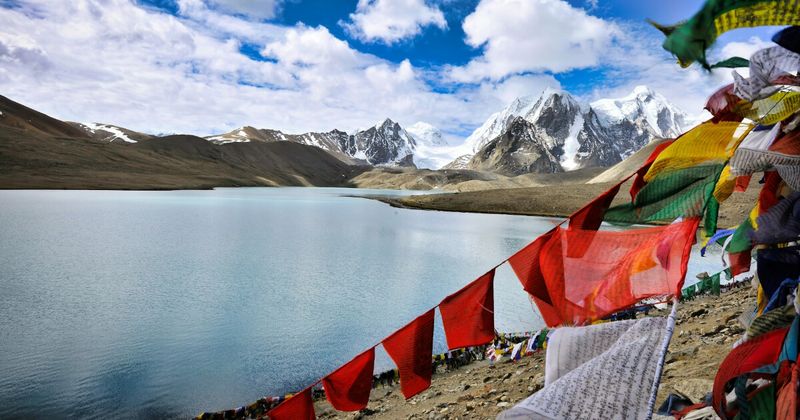
Prayer flags in Tibet and the Himalayan regions are printed with the text of the Wind Horse prayer (Lungta) — a prayer for good fortune, health, and compassion that is carried into the world on the wind.
Book your NJP or Bagdogra departure transfer through KiwiTaxi or GetTransfer — confirmed for the NJP/IXB routes. If combining with a return overnight train to Delhi or Kolkata, book on 12Go Asia well in advance — trains from NJP during October–December peak fill 3–4 weeks ahead.
What to Skip in 8 Days
North Sikkim (Lachung, Yumthang Valley). The rhododendron-covered Yumthang Valley is extraordinary in April–May when 24 species of rhododendron bloom simultaneously. But for foreigners, the PAP process for North Sikkim is more complex (minimum 3 days, 2 nights in North Sikkim, supervised by registered guide throughout), the altitude is significantly higher (Yumthang is 3,564m, Zero Point is 4,800m), and adding North Sikkim to this 8-day circuit requires either extending to 10–12 days or removing Pelling. Pelling stays. North Sikkim is a separate trip.
Nathula Pass. Foreign nationals cannot visit. Plan accordingly and don't be surprised at the Tsomgo checkpoint.
Kalimpong. A charming hill town between Darjeeling and Gangtok — quieter than Darjeeling, famous for its orchid nurseries and Tibetan carpet weavers. It doesn't add structurally to this 8-day circuit but makes an excellent addition if extending to 10 days — insert between Darjeeling and Gangtok on Day 4 instead of Rumtek.
The Darjeeling–Gangtok full toy train. The 7-hour NJP–Darjeeling toy train ride is wonderful — but using it for the arrival day converts a morning arrival into an evening arrival and loses half a day. Save it for the Joy Ride.
Pace and Burnout: Managing the Altitude
This circuit involves three different altitude bands across 8 days: NJP plains (~100m), Darjeeling (2,042m), Gangtok (1,650m), Tsomgo Lake (3,753m), and Pelling (2,150m). The altitude variation is manageable for most visitors but requires a specific approach.
The Tsomgo day-trip altitude spike is the risk point. Going from 1,650m (Gangtok) to 3,753m (Tsomgo) in a single morning is a rapid ascent. Drink water the evening before. Avoid alcohol the night before. Walk slowly at the lake. Descend on schedule — do not extend your time at altitude if you feel unwell. VisitorsCoverage and EKTA policies should include altitude sickness coverage — confirm this when purchasing.
Acclimatise in Darjeeling on Day 1. The rest-day approach on Day 1 is deliberate. Darjeeling is your altitude entry point; give your body the evening to adjust before the Tiger Hill 4am alarm.
Mountain weather is not negotiable. Kanchenjunga is visible on clear mornings only. October–November is the highest-clarity window. December can have cloud by 9am. March–May offers morning clarity but shorter windows. No guide can guarantee mountain views. If the morning is cloudy, the next morning may be clear. This is not a fixable problem — it's the nature of the Himalayas.
Best season: October–December (post-monsoon clarity, pleasant temperatures) and March–May (spring rhododendrons, good visibility). Avoid June–September monsoon.
8-Day Budget Breakdown
| Expense | Budget | Mid-Range |
|---|---|---|
| Flights to Bagdogra (IXB) return | ₹3,600–5,000 ($38–$53) from Kolkata | ₹7,000–12,000 ($74–$128) from Delhi |
| NJP/IXB airport transfer | ₹250 shared jeep to Darjeeling | ₹3,500–5,000 Intui.travel/KiwiTaxi full vehicle |
| Accommodation (8 nights avg) | ₹800–1,500 ($8.51–15.96)/night | ₹3,000–7,000 ($31.91–74.47)/night |
| Tiger Hill entry + jeep | ₹350–450 ($3.72–4.79) | ₹450–550 ($4.79–5.85) VIP |
| Toy Train Joy Ride | ₹805 ($8.56) diesel | ₹1,405 ($14.95) steam — recommended |
| Batasia Loop entry | Free with toy train | Free with toy train |
| Padmaja Zoo (foreigners) | ₹100 ($1.06) | ₹100 ($1.06) |
| Darjeeling–Gangtok vehicle | ₹350–400 ($3.72–4.26) shared jeep | ₹3,500–4,500 Intui.travel full |
| Sikkim RAP/ILP | Free (at Rangpo) | Free |
| Tsomgo Lake PAP + vehicle | ₹800–1,000 ($8.51–10.64) shared | ₹1,500–2,500 ($15.96–26.60) private |
| Gangtok–Pelling vehicle | ₹450–500 ($4.79–5.32) shared | ₹3,500–4,500 Intui.travel |
| Pemayangtse Monastery | ₹50 ($0.53) | ₹50 ($0.53) |
| Rabdentse ruins | ₹50 ($0.53) | ₹50 ($0.53) |
| Rumtek Monastery | Free | Free |
| Tea plantation tour + GI tea purchase | ₹200–500 ($2.13–5.32) | ₹1,000–2,000 ($10.64–21.28) |
| Food (8 days) | ₹300–500 ($3.19–5.32)/day | ₹800–1,500 ($8.51–15.96)/day |
| Klook experiences | — | ₹2,000–4,000 ($21.28–42.55) |
| Travel insurance | VisitorsCoverage/EKTA from ~$18 | from ~$18 |
| 8-day total per person (excl. int'l flights) | ₹20,000–35,000 ($213–$372) | ₹55,000–90,000 ($585–$957) |
All prices INR. USD at ₹94 = $1. INR prices reliable; USD approximate.
Check Live Flight Prices
The Bottom Line
The Darjeeling and Sikkim circuit is the argument for India's east that most first-time visitors never make. It lacks the iconography of the Taj Mahal or the festival chaos of Varanasi. What it has instead is a specific quality of quiet — the quiet of a UNESCO steam engine moving through a hillside bazaar at 15kmph, the quiet of a glacial lake at 3,753 metres on a windless October morning, the quiet of a ruined capital's chortens above a Himalayan valley 211 years after the city was destroyed.
The tea is real here. The mountain is the third-highest on earth and you can see all five of its summits from a monastery terrace for ₹50. The monastery has been standing since 1705. Eight days is enough to understand why people come and not quite enough to stop wanting more.
Your Darjeeling–Sikkim Trip Planning Checklist
🛡️ Travel Insurance — First, Always: VisitorsCoverage — Altitude sickness, mountain weather, and remote road conditions make minimum $100K medical essential; confirm altitude sickness coverage before purchasing; from ~$18–35 USD | EKTA — Second option from $0.99/day at ektatraveling.com; 24/7 multilingual support. Compare both.
✈️ Flights & Delay Protection: FlyFlick — Fly into Bagdogra (IXB); check open-jaw options via Kolkata (CCU) for Delhi/Mumbai arrivals | Compensair — Claim up to €600 for delayed/cancelled flights; IXB fog delays are common in winter.
🚂 Trains — Book 3–4 Weeks Ahead: 12Go Asia — NJP to/from Kolkata, Delhi, Guwahati; Darjeeling Himalayan Railway (DHR) Joy Ride on IRCTC (irctc.co.in) — steam ₹1,405, diesel ₹805; return trains from NJP in October–December sell out fast.
🚖 Transfers: GetTransfer — Pre-booked fixed-fare IXB/NJP airport and station transfers | KiwiTaxi — Confirmed for NJP and Bagdogra airport routes | Intui.travel — Full-day or transfer vehicles: NJP → Darjeeling, Darjeeling → Gangtok, Gangtok → Pelling, Pelling → NJP.
🎟️ Experiences to Pre-Book: Klook — Tiger Hill sunrise + shared jeep (book 48hrs ahead); Toy Train Joy Ride steam engine; Padmaja Zoo ₹100 foreigners; Tsomgo Lake day trip with PAP permit; Pemayangtse Monastery guided visit.
📱 Connectivity: Saily — 5G eSIM; good in Darjeeling and Gangtok main areas | Drimsim — Off-grid eSIM; essential for Tsomgo Lake road, Pelling–Gangtok mountain route, and Pelling valley areas where single carriers drop.
Tea, monasteries, the third-highest peak on earth. Come for 8 days. Leave wishing for more.