
There comes a point in every India traveler’s life when "Goa" stops working.
You get tired of the crowded shacks. You get bored of the trance music. You realize that sipping a beer on a sunbed is nice, but it isn't changing you.
If you are reading this, you are ready for the next level. You are looking for the "Sublime"—that terrifying, beautiful feeling of being small in the face of nature.
In India, that feeling lives in two places:
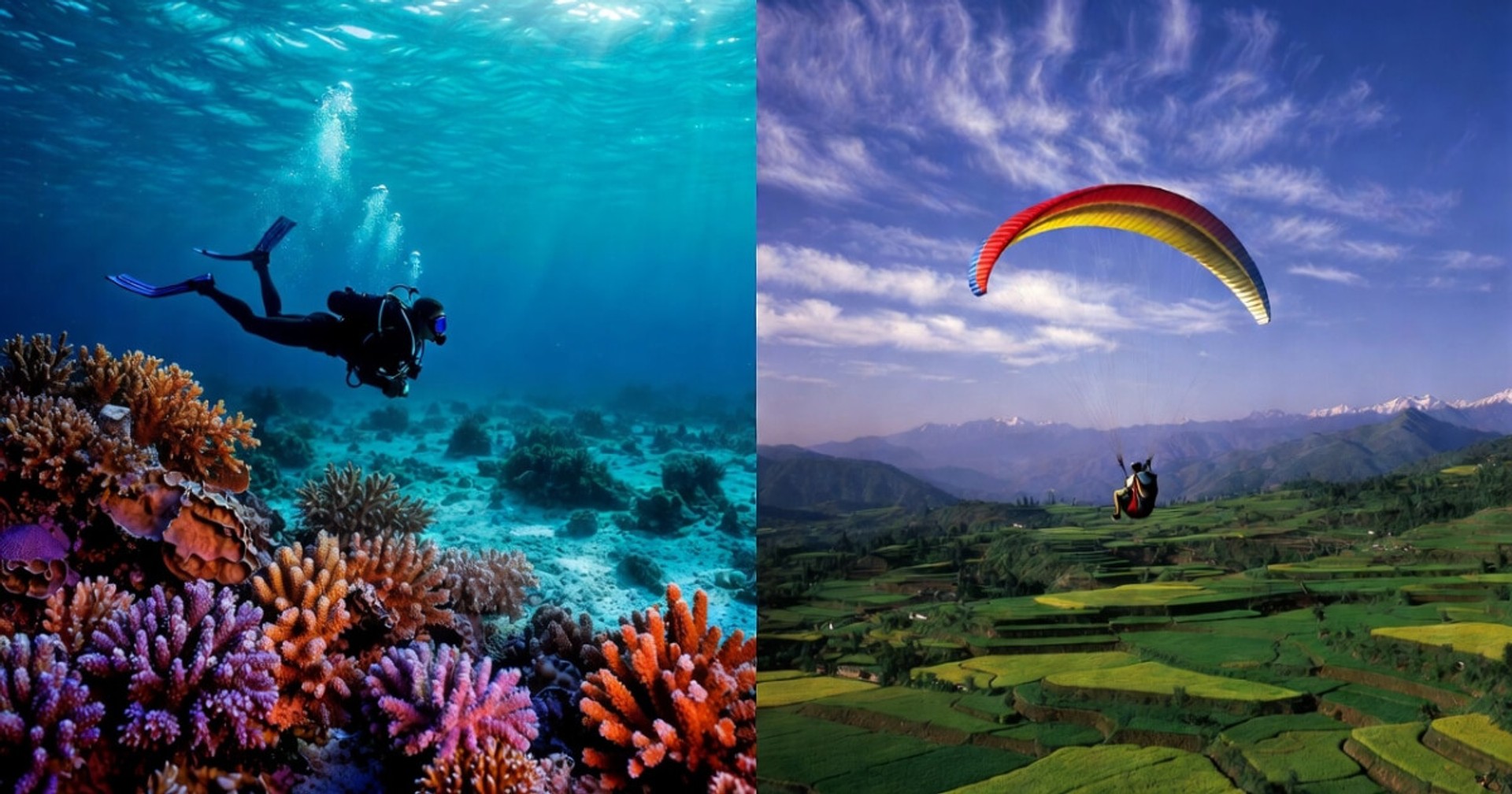
- The Deep: The coral archipelagos of the Andaman Islands.
- The High: The thermal currents of Bir Billing in the Himalayas.
This isn't a generic travel brochure. This is a safety-first, sustainability-focused guide to the two best adventure sports in South Asia. I have broken down the costs, the ethical dilemmas, and the exact logistics of how to get there in 2026.
Let’s choose your adventure.
PART 1: THE OCEAN (Andaman Islands)
Target: Scuba Diving, Freediving, and Marine Conservation.
The Andamans are not "India Light." They are closer to Thailand than they are to Delhi. They are raw, tropical, and home to some of the last healthy coral reefs in the Indian Ocean.
1. The Dilemma: Havelock (Swaraj Dweep) vs. Neil (Shaheed Dweep)
Most blogs tell you to go to Havelock. I am going to give you the nuance.
Havelock Island (The Hub)
- The Vibe: Busy, energetic, filled with backpackers and luxury resorts. This is where the "Big" dive shops are.
- The Diving: World-class. Sites like Johnny’s Gorge and Dixon’s Pinnacle offer chances to see Mantas and small sharks.
- Best For: Serious divers who want to do their PADI Open Water or Advanced courses.
- The Con: It can feel crowded. Radhanagar Beach is stunning but packed at sunset.
Neil Island (The Chill)
- The Vibe: Sleepy, agricultural, and slow. You cycle through paddy fields.
- The Diving: Shallower, calmer, and more colorful. The reefs here (like Bus Stop) are often healthier because they see fewer divers.
- Best For: Couples, "Macro" photography lovers (looking for tiny sea creatures), and those who hate crowds.
- The Con: Fewer ferry connections.
My Verdict: Split your trip. Do 4 days in Havelock for the deep dives, then 3 days in Neil to decompress.
2. The Cost of Diving (2026 Reality)
Scuba is not cheap, but in the Andamans, it is cheaper than the Maldives and safer than Thailand.
Pro Tip: Do not book the cheapest dive shop.
Cheap shops cut corners on air quality and equipment maintenance. Look for PADI 5-Star Centers or SSI Diamond Centers.
3. The Eco-Rule: "Look, Don't Touch"
The Andaman administration is strictly enforcing Plastic Bans.
- You cannot bring plastic bottles onto the ferries. They will be confiscated.
- Sunscreen: Most standard sunscreens kill coral (Oxybenzone). You must bring "Reef Safe" sunscreen (Zinc Oxide based).
- Water: Tap water is not safe. You need a purifier. I used my Grayl Geopress everywhere in Havelock to avoid buying forbidden plastic bottles.
PART 2: THE SKY (Bir Billing, Himachal)
Target: Paragliding, Tibetan Culture, and Mountain Biking.
If the Andamans are about depth, Bir is about height. Located in the Dhauladhar range of the Himalayas, Bir is the world's second-highest paragliding site.
1. Why Bir?
Bir is unique because of its Take-off (Billing) at 8,000 ft and Landing (Bir) at 4,300 ft. The thermal currents here are so consistent that pilots from Europe flock here in October to fly for 6-8 hours straight.
2. Tandem vs. Solo (The Safety Talk)
- Tandem: You are strapped to a pilot. You do nothing but scream and take photos.
- Solo: You are learning to fly yourself.
The "Cowboy" Problem: In 2026, regulation has improved, but there are still unregistered pilots offering "cheap rides" for ₹2,000. Do not take these.
- The Risk: Old gliders, no reserve parachutes, and risky flying to save time.
- The Safe Price: A legitimate, insured tandem flight costs ₹3,000 - ₹4,000.
- Check: Ask to see the pilot's license. If they hesitate, walk away.
3. Best Season to Fly
- October - November: (The Golden Season). The monsoon has washed the dust away. The air is crystal clear. Thermals are smooth. This is when the World Cup happens.
- March - May: (The Strong Season). Thermals are stronger and punchier. Good for experienced pilots, bumpier for tourists.
- Avoid: July - September (Monsoon). Flying is closed.

Paragliding in Bir Billing at sunset; aesthetic wide shot of a person parachuting against a golden Himalayan sky.
PART 3: LOGISTICS (The Boring Stuff That Matters)
Getting to these remote paradises requires strategy.
1. Connectivity: The "Island & Mountain" Challenge
Here is the hard truth: Your standard home SIM card will likely fail in both locations.
- Andamans: Internet is notoriously slow. Mainland SIMs often show "E" (Edge) instead of 4G.
- Bir: Remote mountain pockets have zero signal.
The Solution: The Tri-SIM Strategy I tested three eSIM providers on my last trip. Here is the verdict:
- Option A: Saily (Best for Port Blair & Bir Town)
- Performance: Connected instantly to Airtel/Jio networks. Good for checking emails and maps in the main towns.
- Verdict: Essential for the "Digital Nomad."
- Action: Get 5% Off Saily eSIM
- Option B: Drimsim (Best for Deep Travel)
- Performance: This is a "Universal SIM." In the Andamans, when my main phone died, Drimsim found a weak BSNL signal that saved me. It pays per MB, so it’s a perfect emergency backup for trekkers and divers.
- Verdict: Don't go off-grid without it.
- Action: Check Drimsim Coverage
- Option C: Yesim (Best for Heavy Data)
- Performance: If you are uploading your GoPro footage to the cloud, you need bulk data. Yesim offers unlimited data packs that work well in mainland hubs (Delhi/Chennai) before you transit.
- Action: Get Unlimited Data with Yesim
2. Flights: The "Delay" Factor
- Andamans: You must fly to Port Blair (IXZ) from Chennai or Kolkata.
- Warning: These flights are often delayed due to island weather. I had a 6-hour delay once.
- Bir: You fly to Dharamshala (DHM) from Delhi.
- Warning: Mountain weather cancels flights frequently.
The Insurance Hack: Before I book any flight to these sensitive zones, I register with Compensair. If the weather (or airline incompetence) causes a massive delay or cancellation, they handle the compensation claim. It turns a nightmare into a €600 check.
3. The Last Mile Transfer
- For Bir: You will likely take the Volvo bus from Delhi (12 hours). It drops you at the Tibetan Colony.
- For Andamans: You need ferries (Makruzz or Green Ocean) to get between islands. Book these online weeks in advance. They sell out.
- Action: Search Ferries & Buses on Klook
PART 4: SUSTAINABILITY CHECK
We are guests in these ecosystems.
In the Andamans:
- Coral Bleaching: You will see dead, white coral. It is heartbreaking. Do not stand on the reef. Adjust your buoyancy. If you see trash underwater, put it in your BCD pocket and bring it up.
- Seafood: Avoid eating "Parrotfish" or "Shark." They are crucial for the reef ecosystem. Eat "Snapper" or "Barracuda" instead.
In Bir:
- Waste Management: The mountains have no recycling plants. Whatever plastic wrapper you throw in the bin likely gets burned.
- The Rule: "Pack it in, Pack it out." Carry your trash back to a major city (Delhi/Chandigarh) if possible.
Conclusion: Which One is For You?
Choose the Andamans if:
- You want to disconnect from the world (literally).
- You love water and marine biology.
- You are okay with "Island Time" (slow service, relaxed pace).
Choose Bir Billing if:
- You crave mountain air and Tibetan peace.
- You want high adrenaline followed by meditative walks in monasteries.
- You are on a tighter budget (Bir is significantly cheaper than Havelock).
Either way, you are leaving the tourist trap behind. You are stepping into the wild. And trust me, when you are floating 30 meters underwater or 8,000 feet in the air, you won't miss the beach parties of Goa for a second.
Plan Your Adventure:
- ✈️ Flights: Search Best Routes on FlyFlick
- 📱 Connectivity: Saily (City) | Drimsim (Remote) | Yesim (Data Heavy)
- 🤿 Activities: Book Safe Scuba & Paragliding on Klook
- 🚕 Transfers: InDrive (For Delhi/Chennai airport transfers)
Dive deep. Fly high.